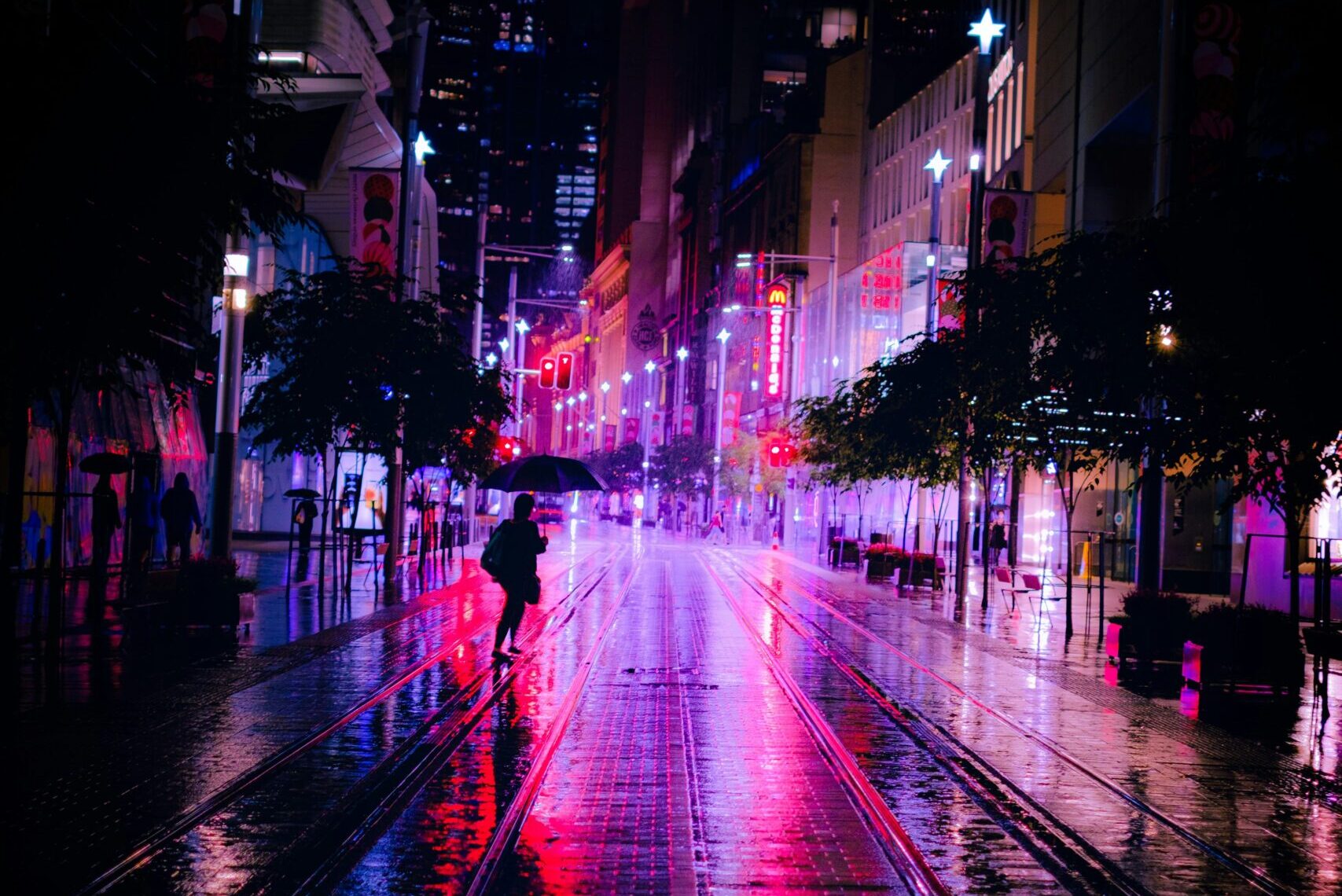
Image: Soheb Zaidi (2020)
Taking up the theme of ‘Nocturnal Cities’, the 2026-2027 ASCA Cities seminar will explore the city after dark. Imaginaries of nocturnal cities unfold across different media, ranging from Gothic themes in literature and film to visions of vibrant urban nightlife in social media, political debates and city marketing. The nocturnal city is both a place and a time, and, as Nick Dunn argues, also a “state of being” (2016). The night changes not just what and how we see in the dark, but also our ways of moving in and through the city – for example due to limited modes of nightly transportation, the alternative centers of nighttime culture and/or continuing concerns around safety in the dark. As a liminal space of excess, noise and disorder that is not just enjoyed but also controlled, managed and policed, the nocturnal city is situated within the tensions of urban regeneration and urban gentrification (cf. Eldridge and Smith 2021; Koren and Hracs 2024; Wicks 2026). In cities like London, Berlin and Amsterdam, the night – and by extension, its cultures and communities – also play a central role from urban policies (e.g. The Amsterdam Night Vision 2021) to national politics (cf. Jazeel 2025). This raises questions about who the night really belongs to.
In this seminar, we approach the nocturnal city as a phenomenon at the intersection of media and culture, adopting an interdisciplinary perspective to address the relationship between darkness and the urban. This also opens up questions about our own engagements with urban nights: What does the nocturnal city look and feel like to its human and more-than-human inhabitants (cf. Andersson 2023; Ironside and Smith 2025)? In what ways does the cityscape, both real and imagined, change when we are surrounded by darkness (cf. Bornus and Scharmann 2025)? And how do the city and nocturnal culture (re)constitute each other? Engaging with and expanding on such questions, the seminar seeks to bring together perspectives from media and culture, cultural and urban geography, sound studies and popular music studies, environmental humanities, anthropology and technology studies as well as architecture and design research.
Co-organized by Carolyn Birdsall, Linda Kopitz and Timo Koren. For more information and registration, please contact Linda Kopitz (l.kopitz@uva.nl) | Dates 12 February to May 2027, exact dates to follow
Programme
Fri. 12 Feb. 2027: Introduction / Reading Session, Time: 3-5pm, Location: room 0.16, Turfdraagsterpad 9, Amsterdam.
Fri. 26 Feb. 2027: Guest Lecture by Timo Koren (University of Amsterdam), Time: 3-5pm, Location: room 0.16, Turfdraagsterpad 9, Amsterdam.
Fri. 12 March 2027: Guest Lecture by Yicun Jin (University of Amsterdam), Time: 3-5pm, Location: room 0.16, Turfdraagsterpad 9, Amsterdam.
Fri. 9 April 2027: Guest Lecture by Rachael Ironside (Robert Gordon University), Time: 3-5pm, Location: room 0.16, Turfdraagsterpad 9, Amsterdam.
Fri. 21 May 2027: Guest Lecture by Tariq Jazeel (University College London), Time: 3-5pm, Location: room 0.16, Turfdraagsterpad 9, Amsterdam.